
Discovering New York's First Cathedral: The Basilica of St. Patrick's Old Cathedral
Most visitors to New York City walk into the beautiful and grand Cathedral on Fifth Avenue, step through its giant bronze doors, look up at its vaulted ceiling, and feel as though they have arrived at the center of Catholic New York.
Truth be told, it actually began nearly 3 miles south on Mott Street in what's now known as Nolita — short for Northern Little Italy.
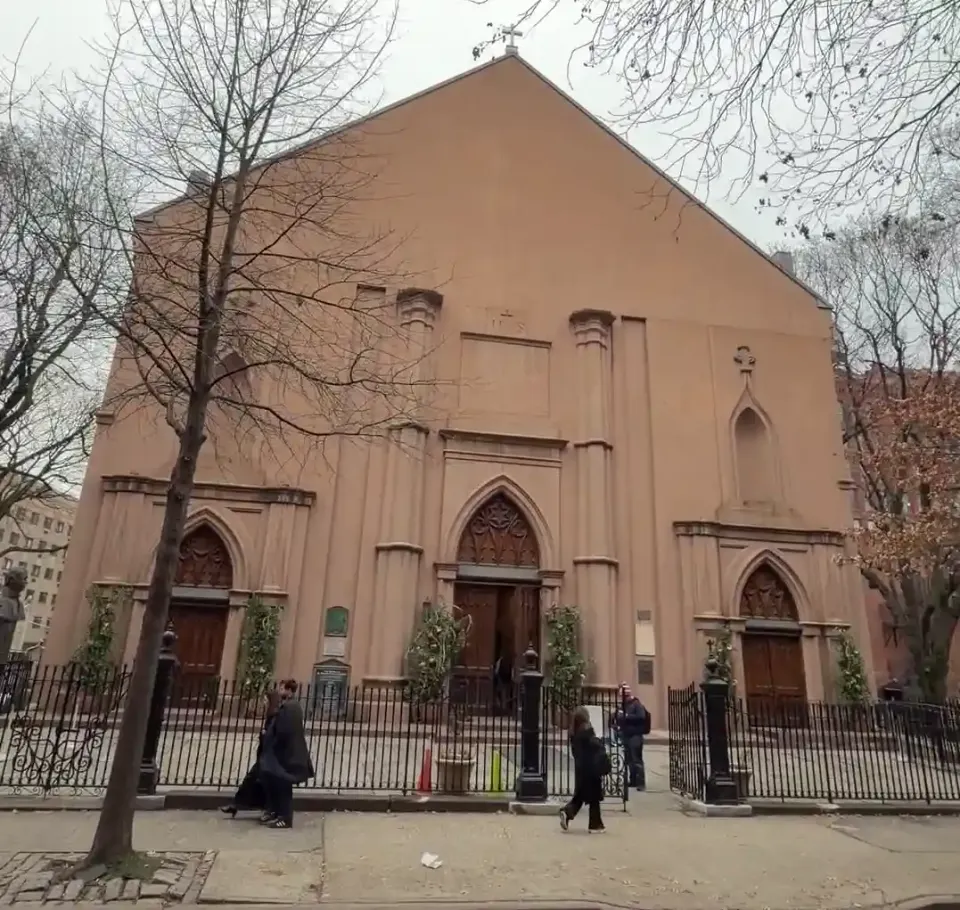
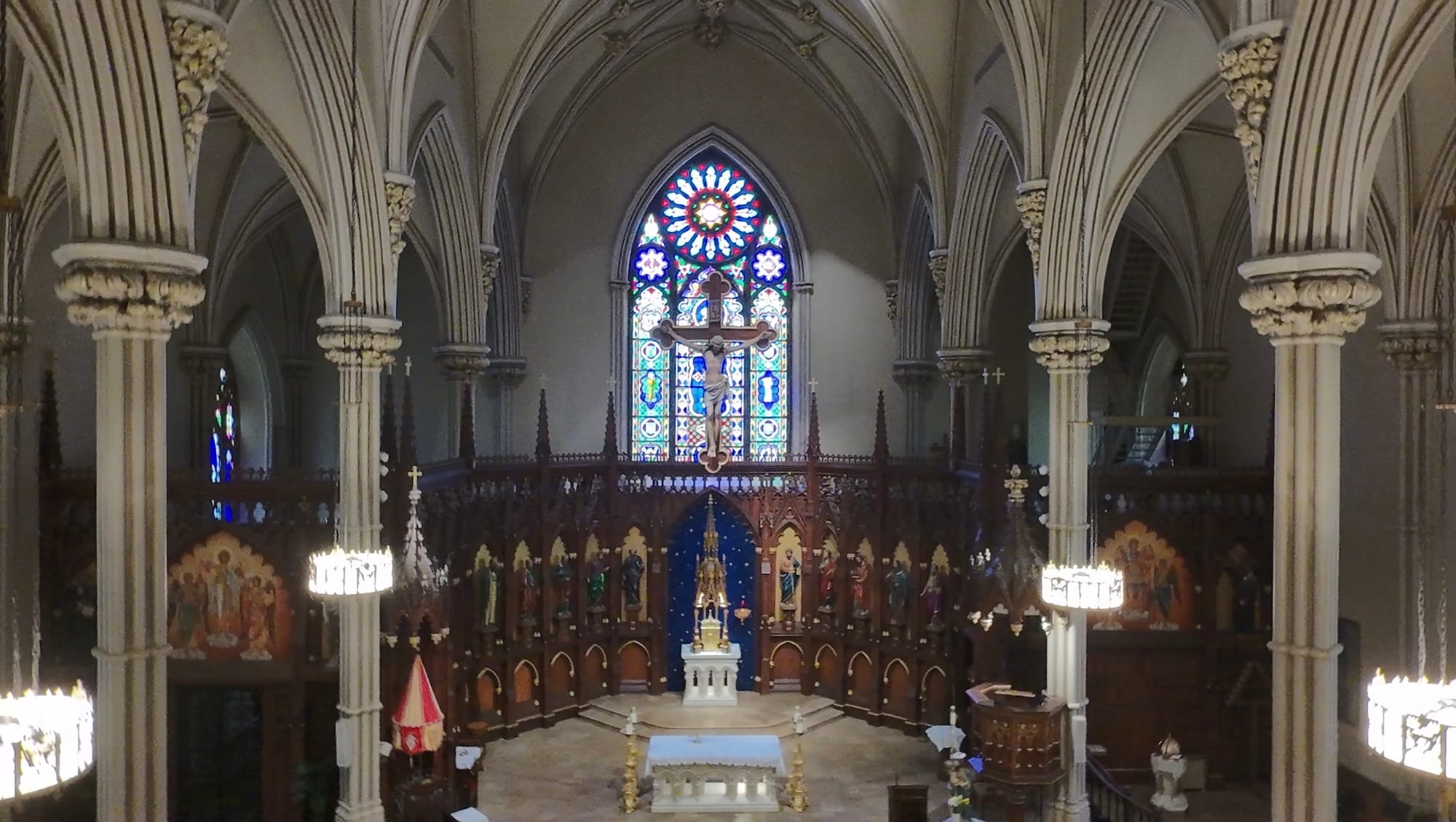
From the outside, you might walk right past it. The facade is spare, windowless, and deliberately austere — the architectural equivalent of a closed book. The walls around it are high, ancient, and give almost nothing away. It is, in every sense, an architectural geode. Crack it open and what's inside takes your breath away — two centuries of sacred history, extraordinary art, and beneath the floor, the only active Catholic catacombs in New York City.
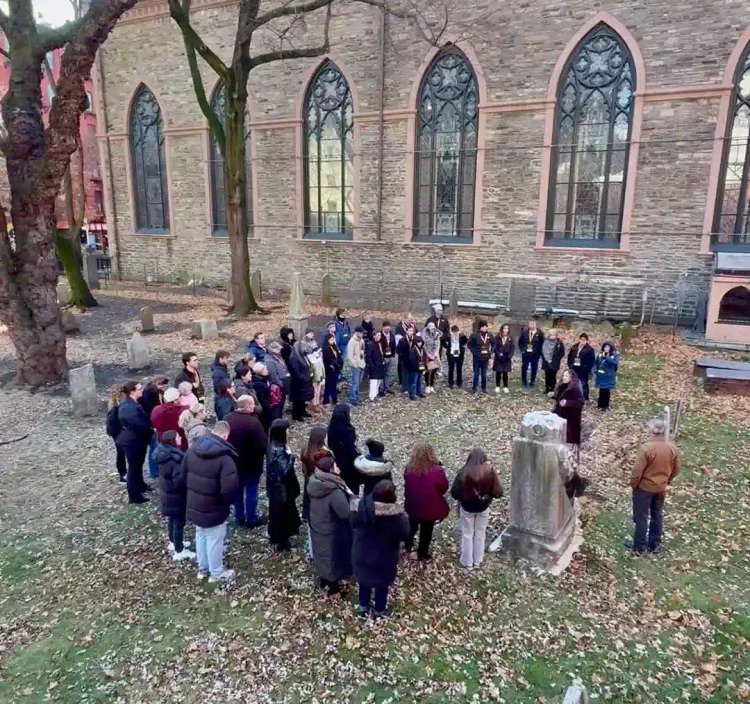
The Basilica of St. Patrick's Old Cathedral sits at the corner of Prince and Mott Streets, enclosed by a two-century-old red brick wall that has become one of the most recognizable and least-explained sights in lower Manhattan (we'll cover the walls in great detail in a later post). It was the first Catholic cathedral in New York City, the largest Catholic church in the entire United States when it was completed, and the seat of the Archdiocese of New York for sixty-four years. Everything that the Fifth Avenue cathedral represents grew from these grounds here.
Here is the story of how it was built, how it burned, how it was rebuilt, and why it endures today.
The Timeline
1801 — Land is acquired for St. Peter's R.C. church on Barclay street in lower Manhattan as a cemetery, which would become the burial ground for New York's early Catholic community and, eventually, the site on which the cathedral would be built.
1809 — The cornerstone is laid on June 8th for what will become the first Catholic cathedral in New York City. The site is well outside the settled city at the time, surrounded by farmland and country houses. So rural, in fact, that a fox was caught in the churchyard not long after the building was completed.
1815 — The cathedral is dedicated on May 14th, Ascension Day. The New York Gazette describes it as "a grand and beautiful church, which may justly be considered one of the greatest ornaments of the city." At the moment of its completion, it is the largest Catholic church in the United States.
1838–1842 — During the final years of Bishop John Dubois's episcopate and under the leadership of his newly appointed coadjutor Bishop John Hughes, crews extend the rear of the cathedral, significantly enlarging the building to hold the city's rapidly growing congregation.
1866 — Fire guts the interior on October 6th. Only the four outer stone walls survive.
1868 — The restored cathedral reopens on St. Patrick's Day.
1879 — The new St. Patrick's Cathedral on Fifth Avenue opens, and St. Patrick‘s Old Cathedral becomes a parish church.
2010 — Pope Benedict XVI elevates St. Patrick's Old Cathedral to a Minor Basilica — one of the rarest and most prestigious honors the Holy See can bestow on a parish church.
2013–2016 — Monsignor Donald Sakano leads a comprehensive restoration of the Church and properties, returning the cathedral to a level of grandeur not seen since its 1868 reopening.
The Architect: A Frenchman Who Shaped New York
In late 1808, recognizing that the newly appointed Bishop Luke Concanen would need an official seat and that Manhattan's booming Catholic immigrant population had completely overwhelmed the original Barclay Street church, the Board of Trustees of St. Peter's voted to build a massive new cathedral. They selected their uptown cemetery land at the corner of Mott and Prince Streets as the location.
The architect chosen was Joseph-François Mangin — a French-born architect who had recently co-designed New York's City Hall alongside John McComb Jr., a project still under construction when the cathedral's cornerstone was laid on June 8, 1809.
Mangin was born in 1758 in the Vosges region of France, studied law in Nancy, and made his way to New York by way of Haiti, where he had worked as a surveyor before the slave revolts of 1791 forced him to leave. In New York he became a protégé of Alexander Hamilton, was hired to design fortifications for New York Harbor, and eventually built two of the most enduring structures in the city's history — City Hall and Old St. Patrick's.
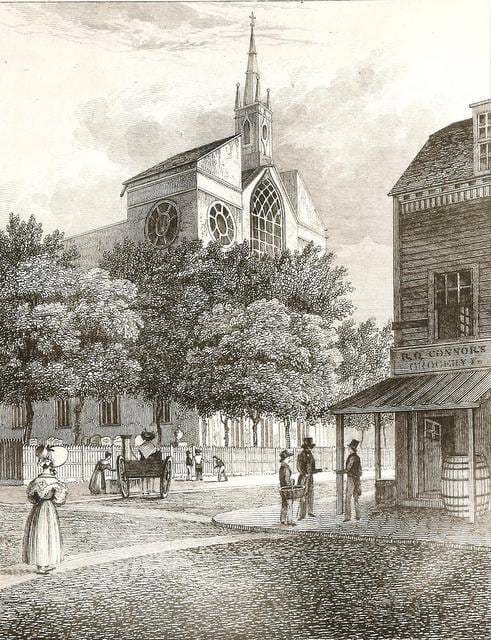
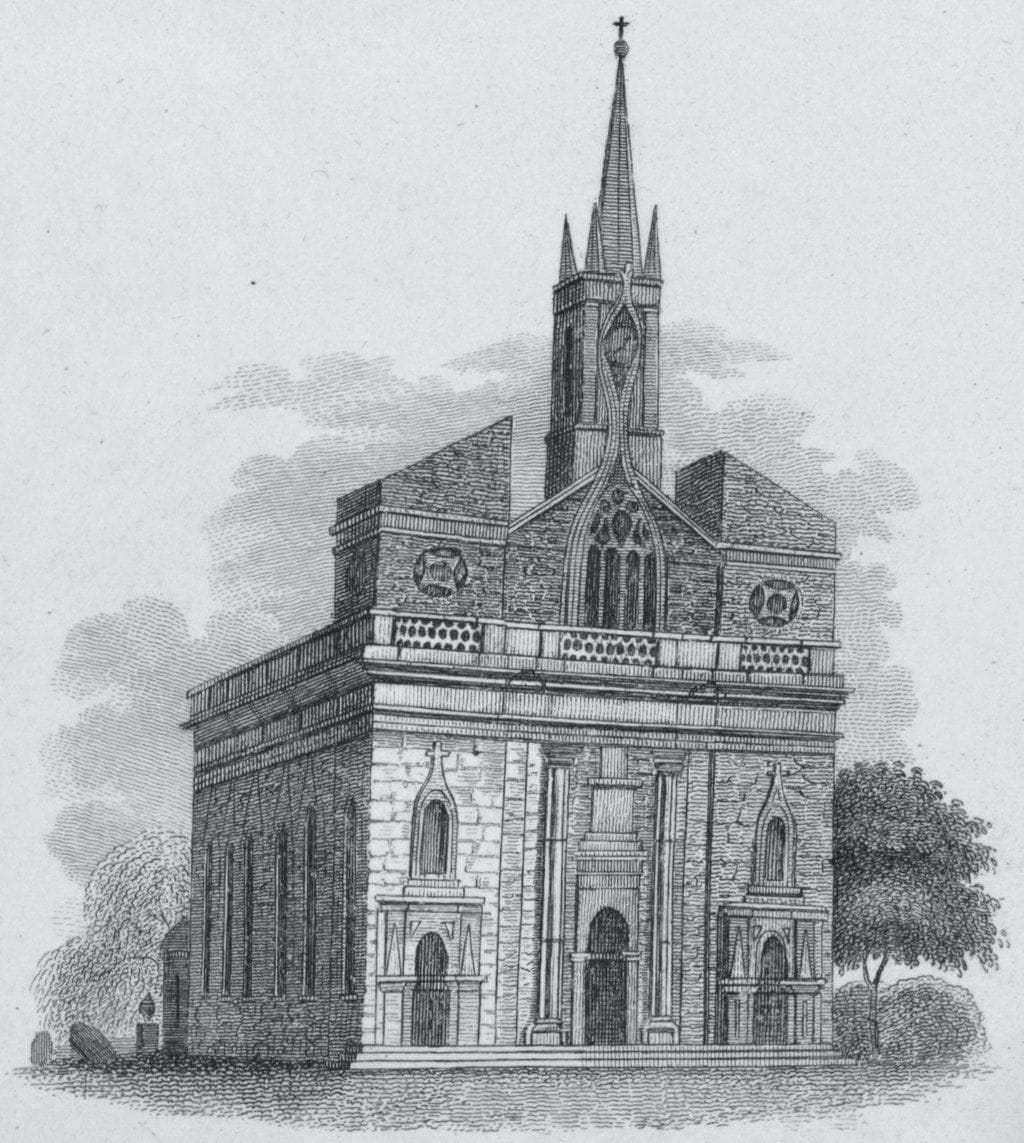
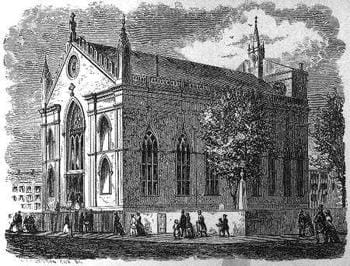
His design for the cathedral was one of the first applications of the Gothic Revival style in the United States. Mangin brought his French training to bear on a decidedly Federal-style brick-and-stone framework — the main Mott Street entrance featured two quasi-towers flanking the facade, creating a broken pediment pierced by a massive, graceful Gothic window. Above it rose a soaring wooden crown, a belfry, and a towering spire. Large stained-glass windows flooded the nave with light. It was, by every account, a building that announced the arrival of the Catholic community in New York in unmistakable terms.
The Extension of 1838–1842
By the late 1830s the cathedral was straining under the weight of its own success. The Catholic population of New York had grown explosively — driven by waves of immigration, primarily from Ireland. To put this into context: in 1815, there were approximately 15,000 Catholics in the Diocese of New York. By 1838, that population had exploded to around 200,000. The building that had seemed so grand at its dedication was no longer equal to the congregation it served.
During the final years of Bishop John Dubois's episcopate, and under the active direction of his newly appointed coadjutor Bishop John Hughes, a major expansion was undertaken. From 1838 to 1842, crews extended the rear of the cathedral significantly, enlarging the building to accommodate the city's rapidly growing faithful. It was one of the first major acts of Hughes's leadership in New York — and a sign of the ambition that would define his tenure for the next two decades.
The Fire of 1866
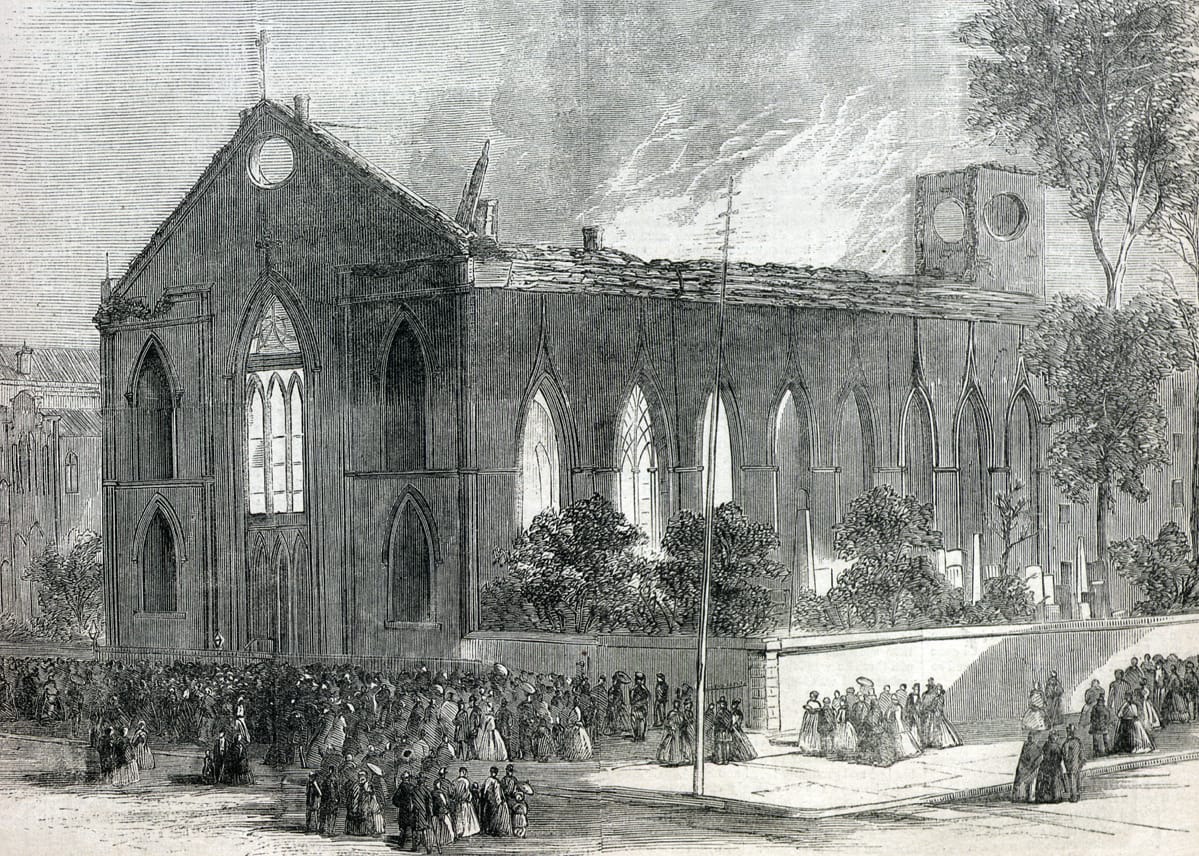
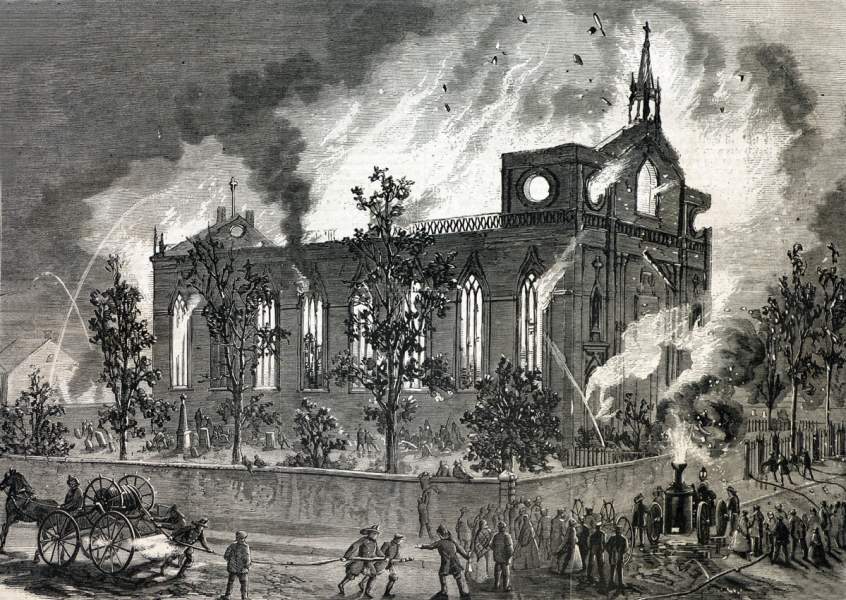
On the night of October 6, 1866, sparks from a fire at a porcelain and glass warehouse on Crosby Street — operated by Vogt & Co. — leapt to the cathedral roof. What followed was a five-alarm blaze that gutted the building entirely. The total loss was estimated at $150,000 — insured for only $75,000. Contemporary newspaper accounts described a dramatic and devastating scene — the interior engulfed in roaring flame while the stained-glass windows cast their dying light across the nave. Roughly $20,000 worth of sacred artifacts were rescued from the burning building. On the Mulberry Street side, a cross survived the inferno intact, reported to be standing amid what witnesses described as a fiery halo. Mangin's wooden crown, the belfry, the spire, and the stained-glass windows were destroyed. When the smoke cleared, only the four outer stone walls were standing.
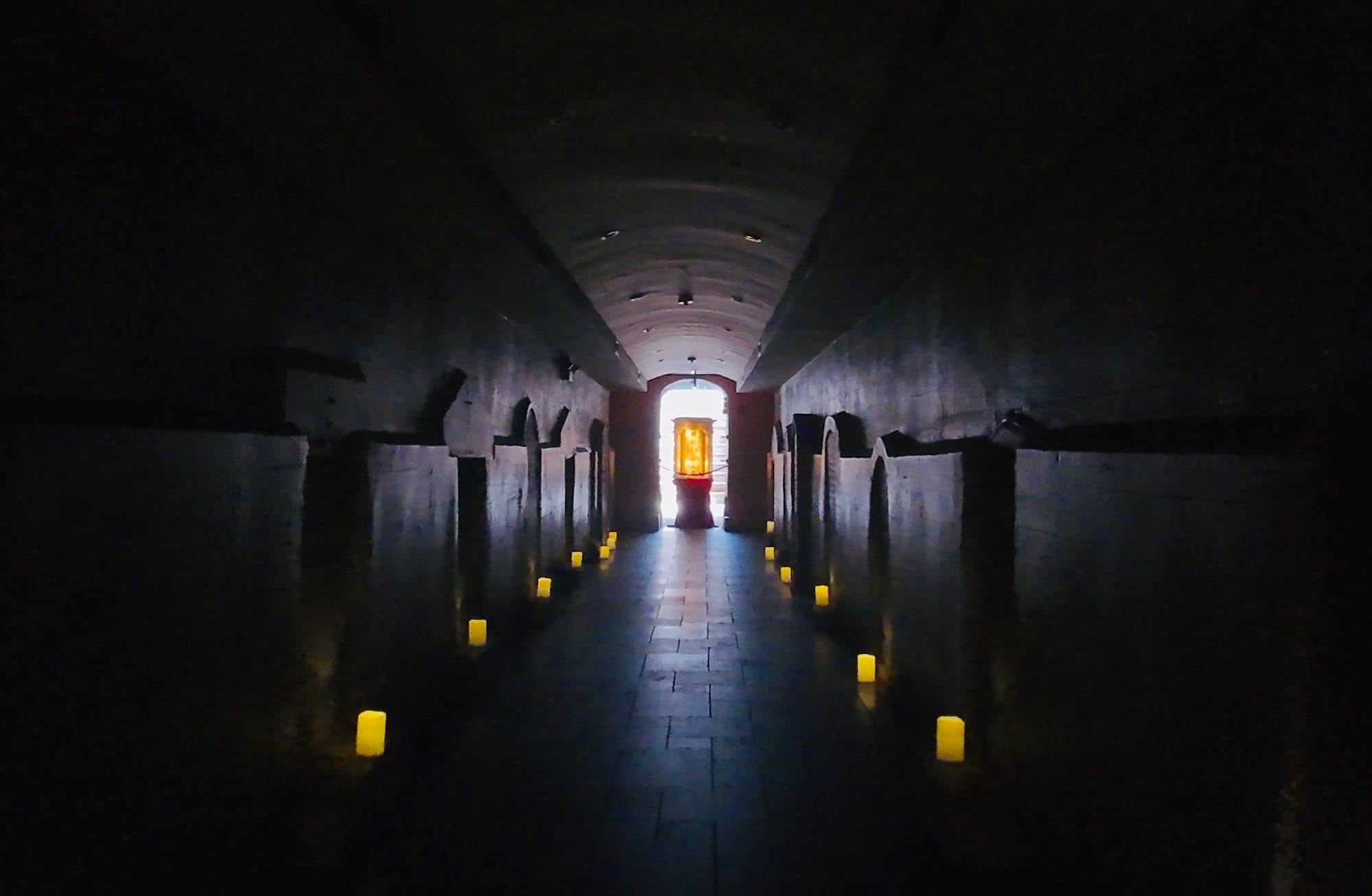
Remarkably, the burial vaults beneath the cathedral floor were entirely untouched by the fire — the same catacombs that exist today survived the blaze of 1866 intact.
The new St. Patrick's Cathedral on Fifth Avenue was already under construction uptown. Many assumed the old building would be abandoned. Archbishop John McCloskey refused. He moved quickly to restore it, commissioning architect Henry Engelbert — better known for his grand Second Empire style buildings — to lead the reconstruction.
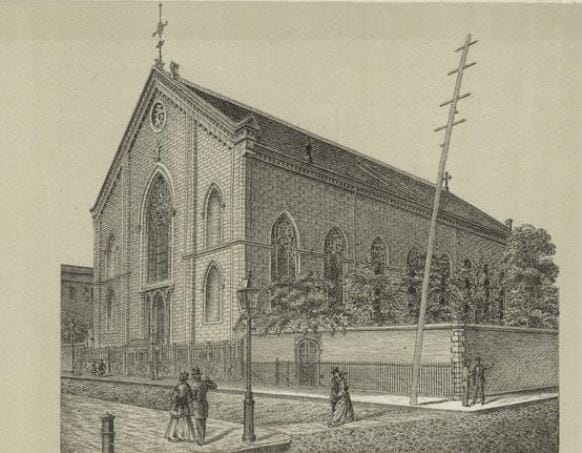
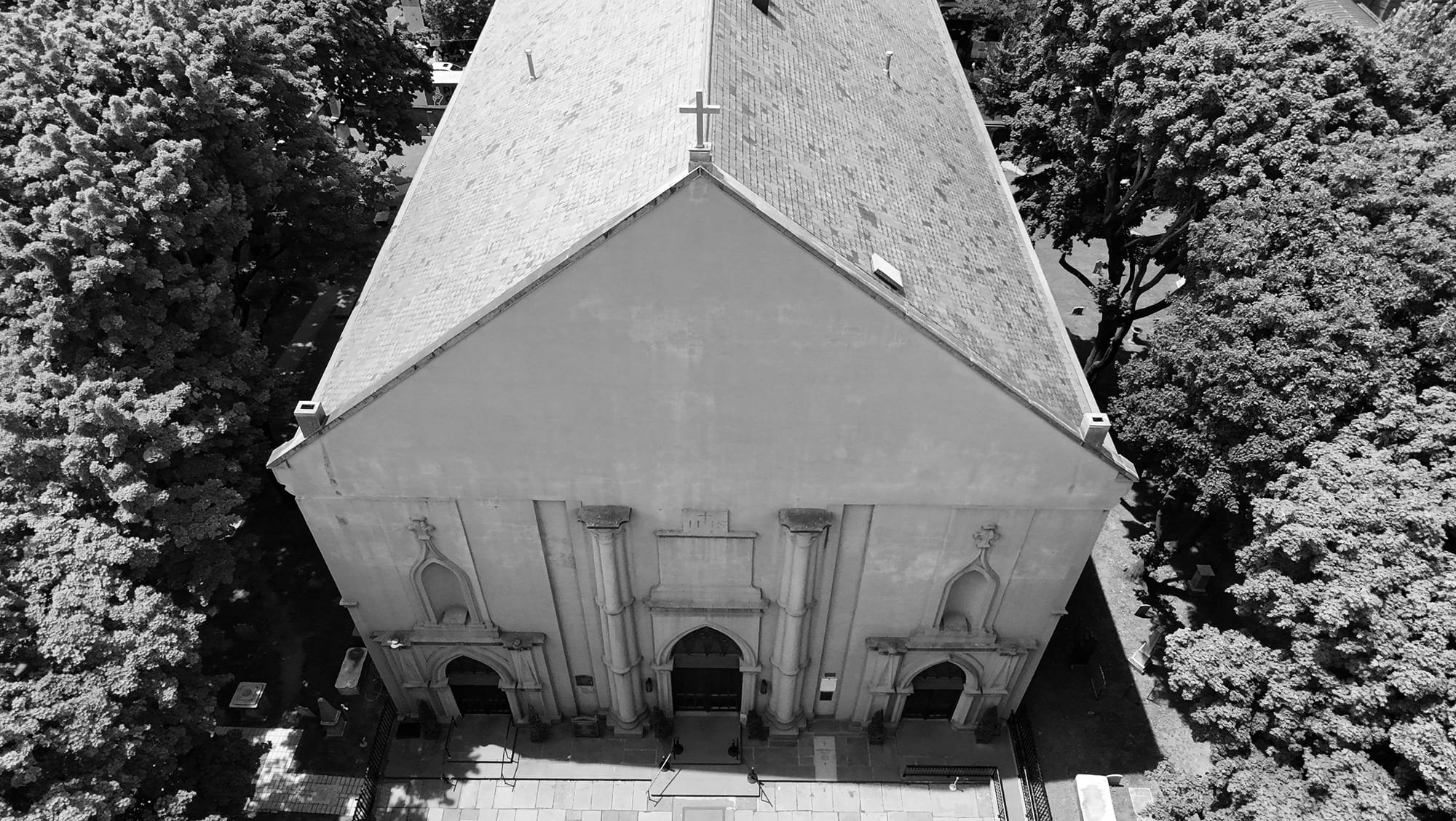
Engelbert's approach was austere by necessity and perhaps by design. The budget did not allow for the reconstruction of Mangin's intricate wooden crown or the grand stained-glass window groupings. What emerged instead was a boxy, spare Gothic structure — simpler, more severe, and in its own way more resilient-looking than what came before. The restored cathedral reopened on St. Patrick's Day, 1868. The face the building wears today is Engelbert's face, born from the fire.
A Century of Restoration
In the years following Engelbert's 1868 reconstruction, Old St. Patrick's underwent a series of restorations as time, weather, and the demands of an active parish took their toll on the building. Each generation tended to it as best it could.
The most transformative work of the modern era came between 2013 and 2016, led by Monsignor Donald Sakano, who had been appointed pastor in 2007 and dedicated nearly a decade of his tenure to returning the cathedral to its full glory. The restoration addressed the building from foundation to finial — the wood, the plaster, the masonry, the historic brick wall, the sanctuary interior. When the work was complete, Old St. Patrick's looked not far from when Engelbert's rebuilt cathedral first opened its doors on St. Patrick's Day, 1868. It was the most comprehensive restoration in the building's history, and it is the church visitors encounter today.
A Basilica
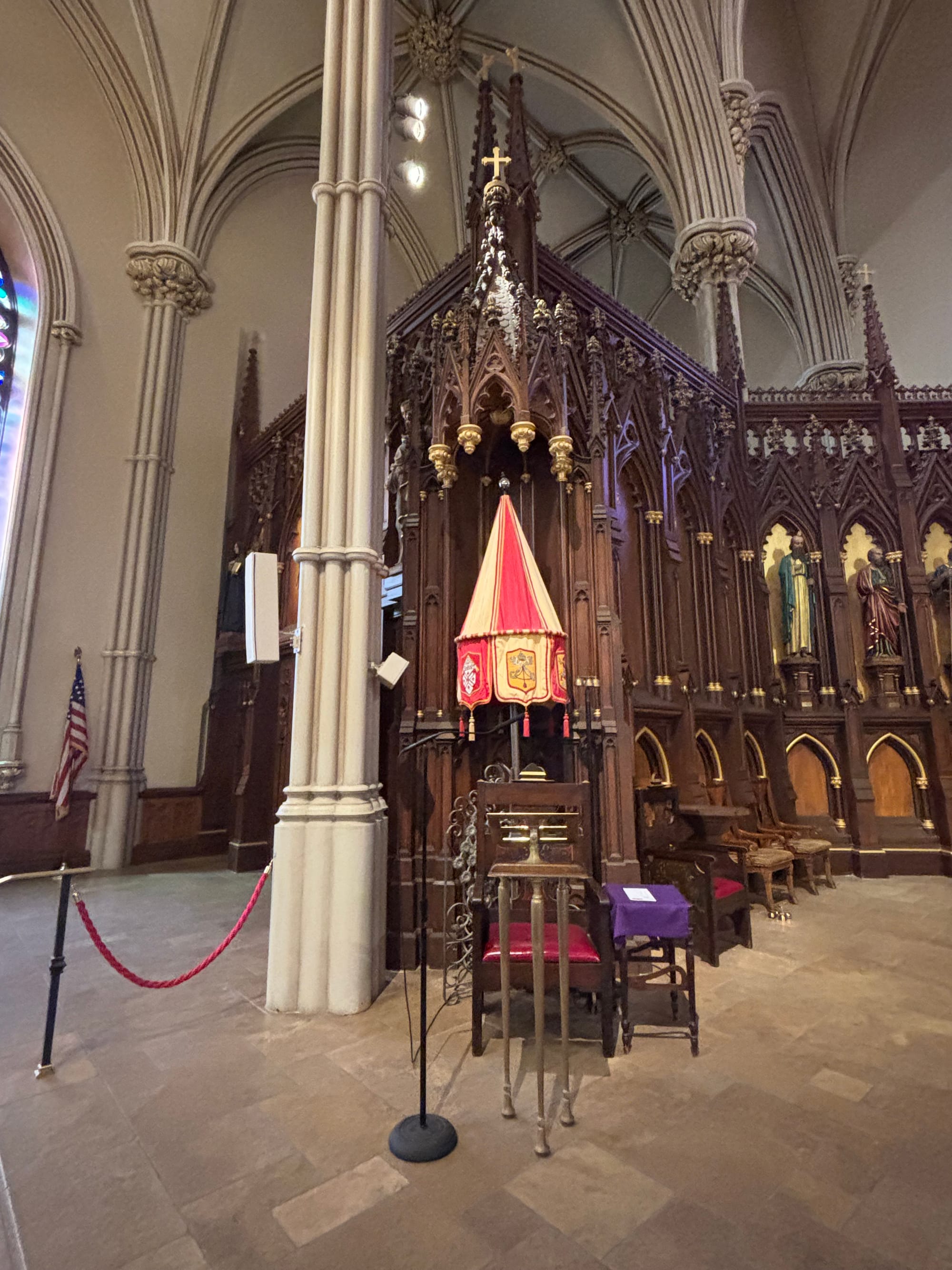
In 2010, Pope Benedict XVI elevated Old St. Patrick's to the status of Minor Basilica — a designation held currently by only 94 churches in the United States. The honor is granted by the Holy See to churches of particular historical, architectural, and spiritual significance. It is not a title the Church gives lightly.
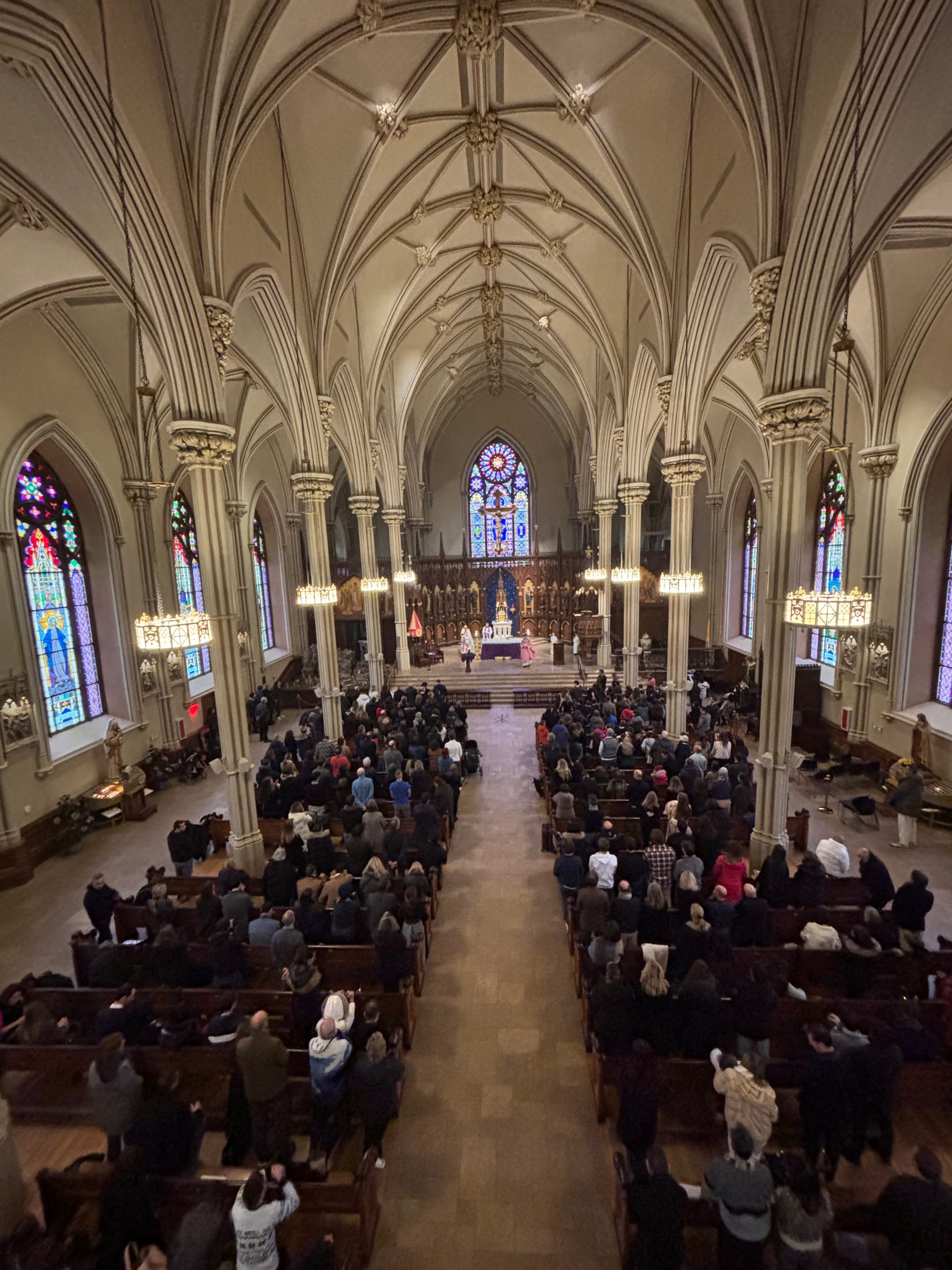
The full official title is the Basilica of St. Patrick's Old Cathedral. It remains an active parish, celebrating daily Mass in English, with Spanish and Italian Masses on weekends, serving close to 2,000 registered parishioners.
What Lies Beneath
The story of the Basilica of St. Patrick's Old Cathedral does not end at the floor of the nave. Beneath it and around it lie a network of crypts, vaults and sarcophagi, graves and underground tombs that have been in continuous use since the early nineteenth century. The catacombs are quite possibly the largest in the country. The bishops who built the American Church, the families who funded the cathedral, the faithful who built this institution from almost nothing — many of them resting here peacefully.
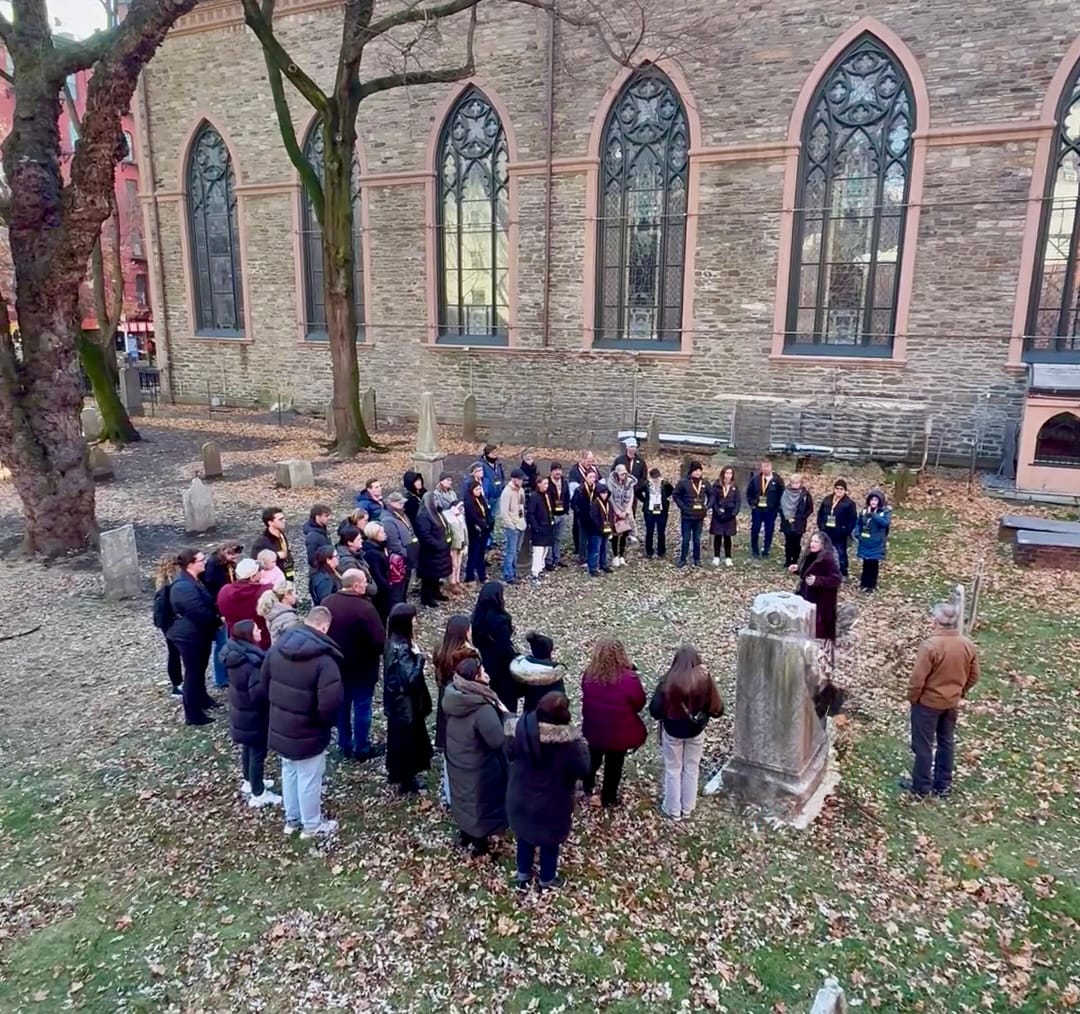
The catacombs are not open to the public in the ordinary sense. Tommy's New York, in partnership with the Basilica, offers the Catacombs by Candlelight tour — the only tour of the underground chambers available to the public, conducted by candlelight in the very spaces where this history was made.
The Basilica Heritage Series offers a deeper program of experiences for those who want to go further — into the history, the architecture, the art, and the sacred grounds of this extraordinary place.
The Basilica of St. Patrick's Old Cathedral has been standing on Mott Street for more than two centuries. It has survived fire, displacement, neglect, and the relentless pressure of a city that never stops changing. It is still here. And the best of it is underground.
The historical content published on Stories of New York is researched, written, and edited solely by Thomas P. Wilkinson of Tommy's New York. While every effort is made to ensure accuracy, all information presented reflects independent research and the personal views of the author. The Basilica of St. Patrick's Old Cathedral, the Archdiocese of New York, and their respective representatives bear no responsibility for the content, accuracy, or conclusions expressed in these posts. Any errors, omissions, or inaccuracies are entirely the responsibility of Tommy's New York. We are committed to maintaining the integrity of the history we cover and will update posts periodically as new information becomes available or corrections are warranted. If you have information that may improve the accuracy of any post, we welcome your feedback at info@takeawalk.com.
Book the Catacombs by Candlelight tour and explore the Basilica Heritage Series at takeawalk.com
Member discussion